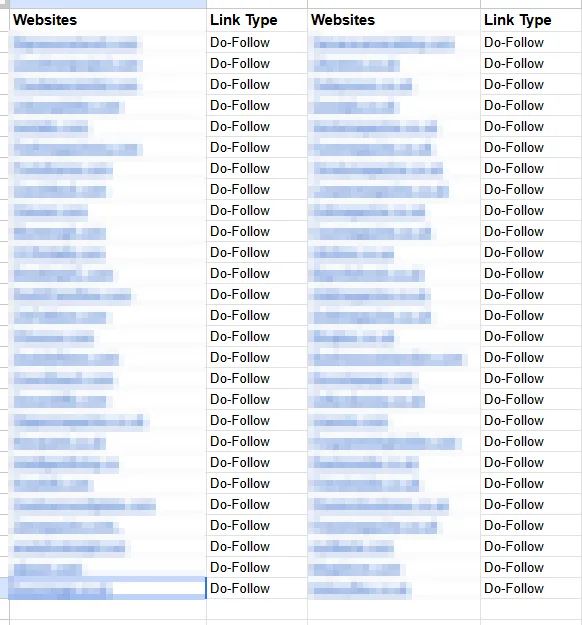
This morning someone filled in my contact form with a list of 54 websites, every one offered as a do-follow link. It wasn't a lead. It was an offer to buy backlinks, and I get one most days.
If you run a business site, you get them too. They arrive by email or through your contact form, with a spreadsheet of sites and a price per link, often around $20.
The short answer: don't buy. If someone is offering you links from a list, at least nine times out of ten the sites exist only to sell links. Google knows these sites. Cheap and easy links aren't worth having. The links that help are hard to get and cost real effort.
Here's what these lists look like, why they target you, and how to check any site in a minute.
What the list looks like
The one I got today is small. Some sellers send tens of thousands of sites; this one sent 54. That size usually means a single operator's own network.
The patterns repeat on every list like it:
- Every link is do-follow. That's the selling point, so it's the only column that matters to them.
- Generic names. "News", "magazine", "daily", "insider", "times". Plenty of .co.uk domains to look local to UK buyers.
- No topic. Tech, fashion, business, history and local news all sit on the same list. A real site is about something.
- Names that sound fine. Some would pass at a glance. That's deliberate.
I opened about ten of them. Every one was made for links, and I could tell within a second of landing.
Why they send it to you
Sellers don't send these lists to SEO people. We delete them. They're fishing for business owners who've heard their site needs backlinks, know they're hard to get, and get an email offering them for $20 each. That sounds reasonable, so they buy.
It works often enough to keep the lists coming. Through a contact form, it's worse: the message lands in your lead inbox and looks like an enquiry.
I've seen what it leads to. One business owner came to me after years of buying links like these. They'd worked for a while. Then Google penalised his site and he lost around half his organic traffic. The business had run on organic search for years, and he was facing laying off half his staff. I picked up the slack with Google Ads, and that's what kept the business going.
What the data says
I ran all 54 sites through the same data Search Principle uses. No names, just the pattern.
| Measure | Result across the 54 sites |
|---|---|
| Typical third-party authority score (0–100) | 49. 40 of the 54 score 40 or more. |
| Estimated monthly visits from Google UK | 34 typical. 38 of the 54 get under 100. |
| The 22 .co.uk sites: monthly visits from Google UK | 12 typical. 17 of the 22 get under 100. |
| Under 100 visits a month from Google UK and US combined | 18 of the 54. |
"Typical" is the median. Visits are DataForSEO estimates for November 2026, not exact figures.
The .co.uk sites are the giveaway. They're dressed up to look local to UK buyers, and almost nobody in the UK finds them through Google. A handful of the .com sites do get real US traffic, which is why some names on the list look fine. But a site that links to anyone who pays is still a site Google has no reason to trust.
The red flag to look for: a strong authority score with little or no traffic from Google. A real site with that score would have real visitors.
The rule I use: cheap and easy means no
After 20 years in search, my rule is simple.
- Cheap and easy: no. If anyone can buy it for $20, it's worth nothing, and it may cost you a lot more.
- Hard and expensive: yes. A link that takes real effort, a real relationship or real money to earn is the kind that counts.
That applies beyond cold emails. If links are offered to you from a list, whether it's a spreadsheet in your inbox or a marketplace with a catalogue and a basket, treat at least 90% of them as a no.
The reason is simple. If a site will link to anyone who pays, Google has no reason to trust its links. And paying for links that pass ranking value breaks Google's spam policies. The risk is a penalty, and recovery takes a year or more.
How to check a site in a minute
If you still want to look at a site on a list, three checks will tell you most of what you need:
- Search its name. A real site ranks first for its own name. If it doesn't, walk away.
- Check it's indexed. Search
site:example.comwith no space after the colon. No pages, no value. - Land on it and look. Ask whether anyone would read this site if it didn't sell links. If the answer is no, Google has likely reached the same view.
I cover the first two in more detail in How to identify spam and toxic backlinks in your link report.
Frequently asked questions
Is it safe to buy backlinks?
Not from lists or marketplaces. Paid links that pass ranking value break Google's spam policies, and cheap ones sit on sites Google already distrusts.
Why do I keep getting emails offering do-follow links?
Because enough business owners buy. The lists go to everyone, and sellers only need a few people to say yes.
Some of the sites on the list look fine. Are they?
Occasionally a genuine site slips onto a list. Most don't pass a closer look. Check whether it ranks for its own name and is indexed, then judge whether anyone would read it.
How do I stop these messages through my contact form?
You can cut most of them with spam protection on the form and a filter for common phrases like "guest post" and "do-follow". Ignore the rest; replying confirms your address is live.
The bottom line
A list of sites in your inbox is a sales pitch, not an opportunity. If links are cheap and easy to get, they're not worth having. Delete the email and spend the money on something that earns its place.
If you've already bought links like these and want to know where you stand, get in touch and I'll tell you straight.
Book a free 15-min call →